Oracle have officially launched SE One - Like Siebel Analytics only cheaper.
This is the pricing package we have all been waiting for. There is no excuse for any company to not buy Analytics. This can be used for what Analytics is good at => RAD (DSDM) warehouse projects. Finance departments should take a really good look at replacing their Access Databases with this.
You'd think I had shares in Oracle (I Don't)!
http://searchoracle.techtarget.com/originalContent/0,289142,sid41_gci1262237,00.html
Friday, June 29, 2007
Wednesday, June 27, 2007
Freedom of the City
I had a great day today. I had to go to the Camberlains court and swear allegiance to the Queen and to the Lord Mayor. We (my wife and I) were then granted the Freedom of the city of London.
I can now drive sheep over tower bridge.
Monday, June 25, 2007
Interesting Note from Oracle
This note was published today. It may explain the questions I have been getting.
"The Standard Cost General table (W_STANDARD_COST_G) and the Exchange Rate General table (W_EXCH_RATE_G) are general reference tables.
Both tables have surrogate keys (ROW_WID). But unlike dimension surrogate keys, these surrogate keys are not referenced as foreign keys by any fact tables. Therefore the general tables do not participate in the star schema. They are not designed for use in reports and queries.
The general tables are intended for use as lookups during Extract-Transform-Load (ETL). For example, the Standard Cost General table provides cost information for a particular product in a particular inventory. The cost information will then be stored in the fact table directly. Similarly, the Exchange Rate General table provides the exchange rate between a pair of currencies for a specific day, given the exchange rate type.
The following are some WIDs in the general tables. They are not necessarily populated and they are not intended for use. These columns are:
W_STANDARD_COST_G.PRODUCT_WID
W_STANDARD_COST_G.CREATED_BY_WID
W_STANDARD_COST_G.CHANGED_BY_WID
W_EXCH_RATE_G.CREATED_BY_WID
W_EXCH_RATE_G.CHANGED_BY_WID
If you need to have a cost dimension, you need to design a different table. It is not recommended that you alter the Standard Cost General table for this purpose. "
"The Standard Cost General table (W_STANDARD_COST_G) and the Exchange Rate General table (W_EXCH_RATE_G) are general reference tables.
Both tables have surrogate keys (ROW_WID). But unlike dimension surrogate keys, these surrogate keys are not referenced as foreign keys by any fact tables. Therefore the general tables do not participate in the star schema. They are not designed for use in reports and queries.
The general tables are intended for use as lookups during Extract-Transform-Load (ETL). For example, the Standard Cost General table provides cost information for a particular product in a particular inventory. The cost information will then be stored in the fact table directly. Similarly, the Exchange Rate General table provides the exchange rate between a pair of currencies for a specific day, given the exchange rate type.
The following are some WIDs in the general tables. They are not necessarily populated and they are not intended for use. These columns are:
W_STANDARD_COST_G.PRODUCT_WID
W_STANDARD_COST_G.CREATED_BY_WID
W_STANDARD_COST_G.CHANGED_BY_WID
W_EXCH_RATE_G.CREATED_BY_WID
W_EXCH_RATE_G.CHANGED_BY_WID
If you need to have a cost dimension, you need to design a different table. It is not recommended that you alter the Standard Cost General table for this purpose. "
Thursday, June 21, 2007
Professional Indemnity Schedule
Just so I can point people to the evidence, here is our insurance certificate.
Professional Indemnity Schedule
Tuesday, June 19, 2007
Oracle Warehouse Builder Documentation
Today was spent installing Oracle databases and Warehouse tools onto one of the Majendi Laptops. It's good to keep doing these to keep your eye in.
A valuable resource if you cannot memorise everything is :
Oracle Warehouse Builder Documentation
A valuable resource if you cannot memorise everything is :
Oracle Warehouse Builder Documentation
Friday, June 15, 2007
A typical question
Please keep sending in your questions, it's interesting to see what challenges you guys (and Girls - Vicky!) face.
Here's a recent one
Hello Adrian,
I need little help.
Our company is implementing Oracle BI 10.x. We don't have much experience in Siebel Analytics/OBI.
We have few fact tables e.g. W_SALES_PICK_LINE_F, which we need/wish to extend. We are not sure about which methodology we should implement.
When we talked with few SA experts they mentioned we need to extend based on ROW_WID. Well, this column doesn't exists anymore in many fact tables, so currently we are thinking of creating ROW_WID on this F table manually and then create WC_SALES_PICK_LINE_FX and take these two tables in physical layer of RPD.
Additially, we need to create few Informatica mappings, again SA experts pointed out to use Image tables. Our data source is Oracle Applications, I don't have much idea about Image tables, but clearly there is not S_ETL_I_IMGAGe or so tables in Oracle Apps
Please guide us as how to proceed on these two issues.
Thanks in advance
and my answer
I am surprised to hear that ROW_WID has been removed from standard vanilla tables. I don't think your system will work without the ROW_WID field. Add the field back in quick! :)
My advice is to extend an existing table, not to create _FX tables. Providing you keep good control on your alter table scripts there are no issues with extending vanilla tables.
Take a copy of the vanilla mappings and customise these in your custom mappings folders. Do not update the vanilla mappings in place - they will be over written in an upgrade.
You can create your own image tables in the oracle db. The alternative is to use a last modified field in the table being imported.
You only need to create immage tables where there is lots of data, typically more than one million rows
Please can you send me more details on the project. It's good to understand where you are coming from, if you send me your rpd I can provide some feedback
Adrian
-------------------------------------------------------
Mobile: 07801 480900
Here's a recent one
Hello Adrian,
I need little help.
Our company is implementing Oracle BI 10.x. We don't have much experience in Siebel Analytics/OBI.
We have few fact tables e.g. W_SALES_PICK_LINE_F, which we need/wish to extend. We are not sure about which methodology we should implement.
When we talked with few SA experts they mentioned we need to extend based on ROW_WID. Well, this column doesn't exists anymore in many fact tables, so currently we are thinking of creating ROW_WID on this F table manually and then create WC_SALES_PICK_LINE_FX and take these two tables in physical layer of RPD.
Additially, we need to create few Informatica mappings, again SA experts pointed out to use Image tables. Our data source is Oracle Applications, I don't have much idea about Image tables, but clearly there is not S_ETL_I_IMGAGe or so tables in Oracle Apps
Please guide us as how to proceed on these two issues.
Thanks in advance
and my answer
I am surprised to hear that ROW_WID has been removed from standard vanilla tables. I don't think your system will work without the ROW_WID field. Add the field back in quick! :)
My advice is to extend an existing table, not to create _FX tables. Providing you keep good control on your alter table scripts there are no issues with extending vanilla tables.
Take a copy of the vanilla mappings and customise these in your custom mappings folders. Do not update the vanilla mappings in place - they will be over written in an upgrade.
You can create your own image tables in the oracle db. The alternative is to use a last modified field in the table being imported.
You only need to create immage tables where there is lots of data, typically more than one million rows
Please can you send me more details on the project. It's good to understand where you are coming from, if you send me your rpd I can provide some feedback
Adrian
-------------------------------------------------------
Mobile: 07801 480900
Thursday, June 14, 2007
Analytics Projects - Who wants one?
Whilst looking around for my next client I realise that we, as Analytics consultants, need to talk to each other more. Whats more, the consultancies and clients really need a place to go for reliable, experienced Analytics specialists.
I was discussing one new project with Haider and it turns out he worked on it before. It's a small world, and Siebel Analytics has a relatively small client base (my wild guess is 400-500 UK clients, half of which are active).
I know about 75 Analytics consultants. There are probably another 100 out there, perm employees, that may one day become freelance and pop up in the Majendi radar.
At the moment the Agencies have a good control on the Market. There are some that put out adverts for non existant jobs. They are useful to the liquidity of the market and some work hard for their cut of you pay. Just be careful they are not taking too much, the best ones have a fixed percentage with their clients. More than 15% is excessive.
So how do we help consultants? We probably should look at the networking capabilty that's out there, linkedIn, Xing, ecademy, Yahoo, etc, and perhaps set-up an OBIEE/Analytics forum. There we could share thoughts on prices to charge, new projects, help needed, technical stuff, etc. I have started one group on Yahoo, if you fancy joining in, let me know - it's invite only. I'm not sure if this helps the clients though.
Any thoughts?
On the subject of rate. You are what you charge. If you charge a cheap rate, your will be percieved as local quality, if you charge a premium rate you should deliver a premium level of service.
What are those rates? My view is that a certified consultant with 2 years (min 3 projects) Analytics consultant should be charging a minimum of 600 GBP per day. Lead consultants, with 7+ project should be GBP 750 per day. The consultancies will obviously need to charge clients a higher level. Some of the cheaper ones are charging 6-700 euro per day, the better ones, with good experience and efficient work, will be charging 900 plus.
One client I saw recently had a greatdeal with a low cost provider, the problem was they didn;t trust the work, and the estimate for time was nearly double what was really required. The client ends up paying nearly the same for inferior work. Somehow we need to educate that quality is very important to them, not cheapness.
I was discussing one new project with Haider and it turns out he worked on it before. It's a small world, and Siebel Analytics has a relatively small client base (my wild guess is 400-500 UK clients, half of which are active).
I know about 75 Analytics consultants. There are probably another 100 out there, perm employees, that may one day become freelance and pop up in the Majendi radar.
At the moment the Agencies have a good control on the Market. There are some that put out adverts for non existant jobs. They are useful to the liquidity of the market and some work hard for their cut of you pay. Just be careful they are not taking too much, the best ones have a fixed percentage with their clients. More than 15% is excessive.
So how do we help consultants? We probably should look at the networking capabilty that's out there, linkedIn, Xing, ecademy, Yahoo, etc, and perhaps set-up an OBIEE/Analytics forum. There we could share thoughts on prices to charge, new projects, help needed, technical stuff, etc. I have started one group on Yahoo, if you fancy joining in, let me know - it's invite only. I'm not sure if this helps the clients though.
Any thoughts?
On the subject of rate. You are what you charge. If you charge a cheap rate, your will be percieved as local quality, if you charge a premium rate you should deliver a premium level of service.
What are those rates? My view is that a certified consultant with 2 years (min 3 projects) Analytics consultant should be charging a minimum of 600 GBP per day. Lead consultants, with 7+ project should be GBP 750 per day. The consultancies will obviously need to charge clients a higher level. Some of the cheaper ones are charging 6-700 euro per day, the better ones, with good experience and efficient work, will be charging 900 plus.
One client I saw recently had a greatdeal with a low cost provider, the problem was they didn;t trust the work, and the estimate for time was nearly double what was really required. The client ends up paying nearly the same for inferior work. Somehow we need to educate that quality is very important to them, not cheapness.
Insurance time
I just had to renew the Professional Indemnity insurance, which this years comes to over 1,300 pounds!
We use Trafalgar, seem to provide good cover, but not sure if they are the cheapest. However, you can do it all online which saves a huge amount of time.
Use the link to get a quote.
Dear *NAME*,
This mail has been sent to you by *YOUR FRIEND* from *YOUR COMPANY* through our website.
Since 1995, Trafalgar Risk Management has focused on providing computer contractors with specialist insurance cover – Professional Indemnity; Tax & VAT Investigation; Employers’ & Public Liability.
Using state of the art computer systems we can provide quotes; accept applications; accept premium payment and allow you to print out all your relevant documentation out online – within minutes!
Furthermore, by streamlining our purchase & renewal procedures, the reduction in administration costs can be passed back to you, as can be seen in the extremely competitive premiums we offer.
We hope the above will be of interest to you and for further information please visit our website through the following link:
http://www.trafalgar.uk.com/index.asp?r=12692
Regards,
Trafalgar Internet Sales
Trafalgar Risk Management
The Lloyds Building
12 Leadenhall Street
London EC3V 1LP
Tel: 0845 685 2610
Fax: 0845 685 2611
Trafalgar Risk Management Limited is authorised and regulated by The Financial Services Authority under registration number 311662.
Trafalgar Risk Management Limited is a member of the British Insurance Brokers Association
We use Trafalgar, seem to provide good cover, but not sure if they are the cheapest. However, you can do it all online which saves a huge amount of time.
Use the link to get a quote.
Dear *NAME*,
This mail has been sent to you by *YOUR FRIEND* from *YOUR COMPANY* through our website.
Since 1995, Trafalgar Risk Management has focused on providing computer contractors with specialist insurance cover – Professional Indemnity; Tax & VAT Investigation; Employers’ & Public Liability.
Using state of the art computer systems we can provide quotes; accept applications; accept premium payment and allow you to print out all your relevant documentation out online – within minutes!
Furthermore, by streamlining our purchase & renewal procedures, the reduction in administration costs can be passed back to you, as can be seen in the extremely competitive premiums we offer.
We hope the above will be of interest to you and for further information please visit our website through the following link:
http://www.trafalgar.uk.com/index.asp?r=12692
Regards,
Trafalgar Internet Sales
Trafalgar Risk Management
The Lloyds Building
12 Leadenhall Street
London EC3V 1LP
Tel: 0845 685 2610
Fax: 0845 685 2611
Trafalgar Risk Management Limited is authorised and regulated by The Financial Services Authority under registration number 311662.
Trafalgar Risk Management Limited is a member of the British Insurance Brokers Association
Tuesday, June 12, 2007
FAQ 2289: How Do You Customize Default Header Links in the Oracle BI Presentation Services Interface?
This supportweb note came out today. It's well worth looking at if you need to customize the links in your BI Publisher.
FAQ 2289: How Do You Customize Default Header Links in the Oracle BI Presentation Services Interface?
Tuesday, June 05, 2007
Skype
Some say "SCIPE" others "SkyPee"
Whichever you say, it's worth getting it. Free calls. We use it for conferencing.
you can find me on the system as username 'adyward'
www.skype.com
Whichever you say, it's worth getting it. Free calls. We use it for conferencing.
you can find me on the system as username 'adyward'
www.skype.com
Thursday, May 31, 2007
Wednesday, May 23, 2007
The 'WebCatalogServiceSOAPKPI' Outbound Service Web Port
Here's a techie from Justin Townsend. We're working on some interesting ideas and clients (and client bids), where this is relevent.
Using the integrated application (Core Oracle/Siebel modules combined with Analytics & Marketing functionality) relies quiet heavily on the use of web services. These services are invoked in a 'traditional' SOAP interface, providing the communication links between the applications.
In a standard installation of the integrated application, web services are used for: pass-through authentication, execution of Marketing jobs and serving up of Analytics and Marketing resources within the integrated environment.
WebCatalogServiceSOAPKPI, as the name may suggest, serves up resources from the Analytics application which are stored in the web catalog file. Using this service you can access: dashboards, requests, iBots, segments, segment trees and list format definitions.
This WebCatalogServiceSOAPKPI is particularly important where the business has many pre-defined reports (visible on dashboards or via requests). In combination with the definition of a symbolic URL, the web service serves up these pages to the user when they access dashboards related screens in the integrated application.
Symbolic URLs are defined in the core Siebel application; when the application's services are started up, the definitions for these symbolic URLs are stored in the web server cache.
When making changes to symbolic URLs, you need to ensure the cache is cleared to make sure the amended definitions are used by the web service.
Symbolic URLs are defined in:
Administration - Integration > Symbolic URL Administration;
the cache is cleared in:
Administration - Marketing > Servers, Outbound Web Service Port (hyperlink) > Outbound Web Services
Using the integrated application (Core Oracle/Siebel modules combined with Analytics & Marketing functionality) relies quiet heavily on the use of web services. These services are invoked in a 'traditional' SOAP interface, providing the communication links between the applications.
In a standard installation of the integrated application, web services are used for: pass-through authentication, execution of Marketing jobs and serving up of Analytics and Marketing resources within the integrated environment.
WebCatalogServiceSOAPKPI, as the name may suggest, serves up resources from the Analytics application which are stored in the web catalog file. Using this service you can access: dashboards, requests, iBots, segments, segment trees and list format definitions.
This WebCatalogServiceSOAPKPI is particularly important where the business has many pre-defined reports (visible on dashboards or via requests). In combination with the definition of a symbolic URL, the web service serves up these pages to the user when they access dashboards related screens in the integrated application.
Symbolic URLs are defined in the core Siebel application; when the application's services are started up, the definitions for these symbolic URLs are stored in the web server cache.
When making changes to symbolic URLs, you need to ensure the cache is cleared to make sure the amended definitions are used by the web service.
Symbolic URLs are defined in:
Administration - Integration > Symbolic URL Administration;
the cache is cleared in:
Administration - Marketing > Servers, Outbound Web Service Port (hyperlink) > Outbound Web Services
Tuesday, May 15, 2007
What Does Metadata mean
I'm i the middle of writing the book (along with Mark) and I was using the word Metadta alot. Then something happened on a client project which made me realise that few people probably understand what this word actually means.
The OraFaq makes a good start
"Data that is used to describe other data"
But does that clear it up?
How about
"Metadata is information about a particular data set which may describe, for example, how, when, and by whom it was received, created, accessed, and/or modified and how it is formatted. Some metadata, such as file dates and sizes, can easily be seen by users; other metadata can be hidden or embedded and unavailable to computer users who are not technically adept"
Every other definition I see just says "Data about data"
So that clears it up then!
The OraFaq makes a good start
"Data that is used to describe other data"
But does that clear it up?
How about
"Metadata is information about a particular data set which may describe, for example, how, when, and by whom it was received, created, accessed, and/or modified and how it is formatted. Some metadata, such as file dates and sizes, can easily be seen by users; other metadata can be hidden or embedded and unavailable to computer users who are not technically adept"
Every other definition I see just says "Data about data"
So that clears it up then!
Thursday, May 10, 2007
More from Oracle
I have been to two Oracle partner events recently, where I am mainly trying to ge tot he bottom of what their ETL tool strategy is.
The issue is on of platform AND application choice.
The fight is between Informatica, OWB and Data Integrator.
Informatica has a huge head start in the Siebel OLTP to warehouse ETL. The process is built and up-and-runnning in many companies.
However, Oracle just bought Sunopsis (and their Data Integrator tool). They also have OWB.
At one event the salesman assured me that Informatica was still the number one choice for CRM ETL, and there are no plans to replace it - it would just cost them too much money to rewrite everything.
At another event I saw this :
No mention of Informatica!
I'm off to build a new databae and ETL using Data Integrator...
The issue is on of platform AND application choice.
The fight is between Informatica, OWB and Data Integrator.
Informatica has a huge head start in the Siebel OLTP to warehouse ETL. The process is built and up-and-runnning in many companies.
However, Oracle just bought Sunopsis (and their Data Integrator tool). They also have OWB.
At one event the salesman assured me that Informatica was still the number one choice for CRM ETL, and there are no plans to replace it - it would just cost them too much money to rewrite everything.
At another event I saw this :
Oracle Only •OBI – Standard Edition •Oracle Warehouse Builder •Oracle Fusion Intelligence (Requires OBI-EE) •. . . . . . . . . . . | Heterogeneous •OBI – Enterprise Edition •Oracle Data Integrator •Oracle BI Applications •. . . . . . . |
No mention of Informatica!
I'm off to build a new databae and ETL using Data Integrator...
Tuesday, May 08, 2007
Away day
Just got back from our away day. Great fun, talking shop, eating good food, going sailing and meeting up with the lads.
Revealing photos to follow!
Thursday, May 03, 2007
Loyalty Anyone?
Has anyone seen an Analytics repository which connects to the Loyalty vertical? We may be able to come to a commercial agreement with anyone has already built one.
Wednesday, May 02, 2007
My New Yahoo group
I'm going group crazy
Just added a fourth Yahoo group. They're great to share stuff with your mates. We have some club messages and information that needs sharing, so we put this is the group and hey presto everyone is up-to-date. No excuses!

Click to join papercourt
Just added a fourth Yahoo group. They're great to share stuff with your mates. We have some club messages and information that needs sharing, so we put this is the group and hey presto everyone is up-to-date. No excuses!
Click to join papercourt
Monday, April 23, 2007
The Future of CRM
I attended one of Oracle's 'Ask the Experts' seminars on CRM strategy last week, not some thing we often have the time to do, but worth doing for an insight into what makes Oracle tick, and more importantly to meet some real people, many of whom at this particular event were not existing Oracle customers.
The first speaker was a research VP from Gartner, he offered some interesting feedback from their research, most of which should cheer up those of us in the business of configuring CRM apps. Generally speaking they have found there are still plenty of sizable organisations who have still to invest in a CRM solution providing a Single Customer View (the holy grail of CRM).
Their headline statement 'CRM is back in a big way' underlines this, however he went on to say that the majority of current projects are upgrades or reviews adding additional functionality or enhancing existing capabilities.
Marketing, sales and customer service are top of the list of areas perceived most likely to benefit from CRM investment, but it's clear that there are still reservations amongst top level management about the tangible benefits of this investment, and how to measure this. Thankfully, on average Analytics is rated third priority across all three of these areas, usually behind increasing customer satisfaction and improving cross selling opportunities. So more good news for those of us in the analytics business.
However, the flip side to all this optimism is that Gartner predict that by 2009 50% of new investment in this area will be in SaaS, or Software as a Service, also very interesting was the observation that some projects may be delayed until 2008, as purchasers wait for the current round of new releases to settle down and prove themselves.
Next up was Oracle's Sales Consulting Director who had a huge number of slides in his presentation explaining Oracle's current CRM strategy, I got the impression from questions asked by the floor, that this is what prospective purchasers, and some who bought Oracle CRM products pre the Siebel merger, were really interested in. The huge amount of information delivered was quite overwhelming as they tried to encompass JD Edwards, PeopleSoft and Siebel users to make all feel welcome, without making existing Oracle customers feel they might now have a second tier product. In practice the future is Oracle Fusion, a suite of middleware apps to link together all the products now in the Oracle stable, this should allow relatively seem less integration of for example analytics, with any of the CRM/ERP apps offered, with Oracle undertaking to develop these apps in parallel and not force upgrades or conversions on any customer, for Siebel the future 8.1 and 8.2 releases are said to be in the pipeline already.
As reassurance for Siebel users Oracle are using Siebel internally now, with Siebel Contact Centre underpinning the Oracle support team.
Next, a very nice lady from Irish Life, Ireland's biggest life assurance company, gave an interesting presentation on their experiences implementing Siebel, originally a very customised version 6, and currently an upgrade to 7.8, which will now be around 90% vanilla Siebel. The message being that they learned their lesson, and some times less really is more.
So finally we got to the demonstration of Siebel 8, unfortunately time was against us and rumbling tums could be heard, new features include Full System Search, Embedded Analytics, Electronic Signature Capture for mobile clients, task based UIs and a plain English rules engine to aid workflow and control data input.
Then there was a stampeed to the buffet!
The first speaker was a research VP from Gartner, he offered some interesting feedback from their research, most of which should cheer up those of us in the business of configuring CRM apps. Generally speaking they have found there are still plenty of sizable organisations who have still to invest in a CRM solution providing a Single Customer View (the holy grail of CRM).
Their headline statement 'CRM is back in a big way' underlines this, however he went on to say that the majority of current projects are upgrades or reviews adding additional functionality or enhancing existing capabilities.
Marketing, sales and customer service are top of the list of areas perceived most likely to benefit from CRM investment, but it's clear that there are still reservations amongst top level management about the tangible benefits of this investment, and how to measure this. Thankfully, on average Analytics is rated third priority across all three of these areas, usually behind increasing customer satisfaction and improving cross selling opportunities. So more good news for those of us in the analytics business.
However, the flip side to all this optimism is that Gartner predict that by 2009 50% of new investment in this area will be in SaaS, or Software as a Service, also very interesting was the observation that some projects may be delayed until 2008, as purchasers wait for the current round of new releases to settle down and prove themselves.
Next up was Oracle's Sales Consulting Director who had a huge number of slides in his presentation explaining Oracle's current CRM strategy, I got the impression from questions asked by the floor, that this is what prospective purchasers, and some who bought Oracle CRM products pre the Siebel merger, were really interested in. The huge amount of information delivered was quite overwhelming as they tried to encompass JD Edwards, PeopleSoft and Siebel users to make all feel welcome, without making existing Oracle customers feel they might now have a second tier product. In practice the future is Oracle Fusion, a suite of middleware apps to link together all the products now in the Oracle stable, this should allow relatively seem less integration of for example analytics, with any of the CRM/ERP apps offered, with Oracle undertaking to develop these apps in parallel and not force upgrades or conversions on any customer, for Siebel the future 8.1 and 8.2 releases are said to be in the pipeline already.
As reassurance for Siebel users Oracle are using Siebel internally now, with Siebel Contact Centre underpinning the Oracle support team.
Next, a very nice lady from Irish Life, Ireland's biggest life assurance company, gave an interesting presentation on their experiences implementing Siebel, originally a very customised version 6, and currently an upgrade to 7.8, which will now be around 90% vanilla Siebel. The message being that they learned their lesson, and some times less really is more.
So finally we got to the demonstration of Siebel 8, unfortunately time was against us and rumbling tums could be heard, new features include Full System Search, Embedded Analytics, Electronic Signature Capture for mobile clients, task based UIs and a plain English rules engine to aid workflow and control data input.
Then there was a stampeed to the buffet!
Thursday, April 12, 2007
Init Blocks, init.
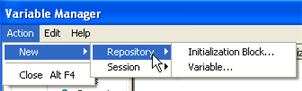
That's repository variable Initialization Blocks to you. Init blocks as they are more commomnly known retrieve the data that is held in memory by the Session and Repository variables associated with them. They are of course accessed through Manage>Variables in the Administration console, and this is another area where subtle changes have been made for Oracle BIEE, to add a new init block open the Variable Manager, click Initialization Blocks and then right click in the righ pane or choose Action>New>Repository>Initialization Block.
Then the configuration itself, no more tabs, one form with buttons.
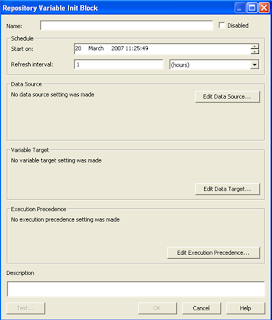
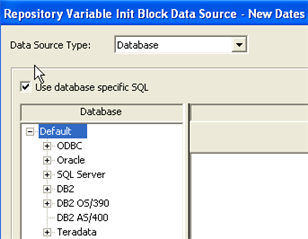
Edit Data Source button gives access
to further options.
Edit Data Target launches what used to be on the Variables tab, click here to name your variables.
Anyway, enough pictures, click on Edit Data Source to reveal the Init Block form where you will compose the initialization String, aka the SQL. You can now select db specific SQL if you wish, and now is also the time to Browse for your connection pool.
Oracle has two functions for returning the current date, SYSDATE and CURRENT_DATE, both should be selected from system dummy table DUAL, as this will always return only one row, sysdate returns the current date on the server.
You can convert to and from datetime types using the following functions;
TO_CHAR ({datetime| interval}, format)
TO_DATE (string, format)
TO_TIMESTAMP (string, format) (Oracle 10g onwards)
To return a specific element of the current date use the EXTRACT function;
SELECT EXTRACT({Second|Minute|Hour|Day|Month|Year} FROM SYSDATE) FROM DUAL;
CAST(value as datatype) If value is a string it must match the default text representation of the datatype, so for example
CAST (’27-Mar-2007’ AS DATE) may work where
CAST(’27-03-2007’ AS DATE
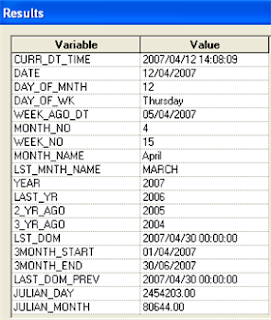
In the following example note how the case format applied to the format part of the TO_CHAR function is used to format the results ‘TUESDAY’ and ‘March’, this could of course have a crucial effect if the value is used in a filter.
Thanks to Oracle’s built in LAST_DAY function, the formula to find the last day of the month, 3 months hence, is simple.
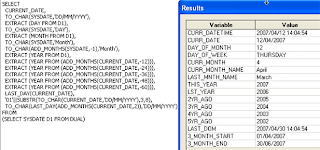
As an alternative method you could of course W_DAY_D as the source for the majority of your dates, pre-calculated columns such as cal_month, cal_week and week_ago_dt will make function statements shorter and easier to read. The SQL below extracts much the same as the previous one with addition of two Julian dates at the end, note also that you can use comments in these statements, always a good idea.
SELECT
CURRENT_DATE,
TO_CHAR(CALENDAR_DATE, 'DD/MM/YYYY'),
TO_NUMBER(DAY_OF_MONTH,'99'),
DAY_NAME,
TO_CHAR(WEEK_AGO_DT, 'DD/MM/YYYY'),
CAL_MONTH,
CAL_WEEK,
MONTH_NAME,
TO_CHAR(ADD_MONTHS(SYSDATE,-1),'MONTH'),
CAL_YEAR,
EXTRACT (YEAR FROM (ADD_MONTHS(CURRENT_DATE, -12))),
EXTRACT (YEAR FROM (ADD_MONTHS(CURRENT_DATE, -24))),
EXTRACT (YEAR FROM (ADD_MONTHS(CURRENT_DATE, -36))),
LAST_DAY(DAY_DT),
'01'||SUBSTR(TO_CHAR(DAY_DT,'DD/MM/YYYY'),3,8),
TO_CHAR(ADD_MONTHS(LAST_DAY(DAY_DT),2),'DD/MM/YYYY'),
ADD_MONTHS((CAST(DAY_DT AS DATE) - EXTRACT(DAY FROM CAST(DAY_DT AS DATE))+1),1)-1, /* Last day of previous month */
JULIAN_DAY_NUM,
JULIAN_MONTH_NUM
FROM
W_DAY_D
WHERE
CAST(SUBSTR(SYSDATE,1,10) AS DATE)=DAY_DT
Then the configuration itself, no more tabs, one form with buttons.


Edit Data Source button gives access
to further options.
Edit Data Target launches what used to be on the Variables tab, click here to name your variables.
Anyway, enough pictures, click on Edit Data Source to reveal the Init Block form where you will compose the initialization String, aka the SQL. You can now select db specific SQL if you wish, and now is also the time to Browse for your connection pool.
Oracle has two functions for returning the current date, SYSDATE and CURRENT_DATE, both should be selected from system dummy table DUAL, as this will always return only one row, sysdate returns the current date on the server.
You can convert to and from datetime types using the following functions;
TO_CHAR ({datetime| interval}, format)
TO_DATE (string, format)
TO_TIMESTAMP (string, format) (Oracle 10g onwards)
To return a specific element of the current date use the EXTRACT function;
SELECT EXTRACT({Second|Minute|Hour|Day|Month|Year} FROM SYSDATE) FROM DUAL;
CAST(value as datatype) If value is a string it must match the default text representation of the datatype, so for example
CAST (’27-Mar-2007’ AS DATE) may work where
CAST(’27-03-2007’ AS DATE
In the following example note how the case format applied to the format part of the TO_CHAR function is used to format the results ‘TUESDAY’ and ‘March’, this could of course have a crucial effect if the value is used in a filter.
Thanks to Oracle’s built in LAST_DAY function, the formula to find the last day of the month, 3 months hence, is simple.

As an alternative method you could of course W_DAY_D as the source for the majority of your dates, pre-calculated columns such as cal_month, cal_week and week_ago_dt will make function statements shorter and easier to read. The SQL below extracts much the same as the previous one with addition of two Julian dates at the end, note also that you can use comments in these statements, always a good idea.
SELECT
CURRENT_DATE,
TO_CHAR(CALENDAR_DATE, 'DD/MM/YYYY'),
TO_NUMBER(DAY_OF_MONTH,'99'),
DAY_NAME,
TO_CHAR(WEEK_AGO_DT, 'DD/MM/YYYY'),
CAL_MONTH,
CAL_WEEK,
MONTH_NAME,
TO_CHAR(ADD_MONTHS(SYSDATE,-1),'MONTH'),
CAL_YEAR,
EXTRACT (YEAR FROM (ADD_MONTHS(CURRENT_DATE, -12))),
EXTRACT (YEAR FROM (ADD_MONTHS(CURRENT_DATE, -24))),
EXTRACT (YEAR FROM (ADD_MONTHS(CURRENT_DATE, -36))),
LAST_DAY(DAY_DT),
'01'||SUBSTR(TO_CHAR(DAY_DT,'DD/MM/YYYY'),3,8),
TO_CHAR(ADD_MONTHS(LAST_DAY(DAY_DT),2),'DD/MM/YYYY'),
ADD_MONTHS((CAST(DAY_DT AS DATE) - EXTRACT(DAY FROM CAST(DAY_DT AS DATE))+1),1)-1, /* Last day of previous month */
JULIAN_DAY_NUM,
JULIAN_MONTH_NUM
FROM
W_DAY_D
WHERE
CAST(SUBSTR(SYSDATE,1,10) AS DATE)=DAY_DT
Subscribe to:
Posts (Atom)
The Cowes
Cowes Racing